An FPGA-BASED Digital Logic Core For ATE Support and Embbedded Test Applications
From Summary:
The Digital Logic Core is proposed in this thesis to address the technological
and economical challenges facing the IC test industry today. The DLC is a
customized circuit that is incorporated into the test environment to enhance the
testability of the DUT by supplementing automatic test equipment (ATE)
capabilities, providing a standalone test bed, or embedding test functionality into
larger systems.
The enabling technology of the DLC is programmable logic, such as field-
programmable gate arrays (FPGAs), which off-loads the ATE test logic and
functions. Previous work used FPGAs for applications which required low speed,
but high test channel count. With the rapid advancement of FPGA technology, the
DLC can now perform most test functions of ATE while maintaining and exceeding
their performance. This level of complexity can be attained while drastically
reducing the cost of current test systems. Furthermore, the rapid development of
FPGA technology exceeds the rate of ATE improvement making this test strategy
more useful into the future.
To demonstrate the feasibility of this concept, several applications are
developed and analyzed including an opto-electronic test bed for standalone
operation and a nano-scale wafer-level prober for embedded system operation.
These systems have been proven to operate at multi-gigahertz speeds which match
and exceed modern ATE specifications. More applications are planned for the near
future which far exceed these rates.
Downloads:
Wuala
Emule
Magnet
Mostrando postagens com marcador FPGA. Mostrar todas as postagens
Mostrando postagens com marcador FPGA. Mostrar todas as postagens
domingo, 20 de dezembro de 2009


FPGA-based Implementation of Complex Signal Processing System
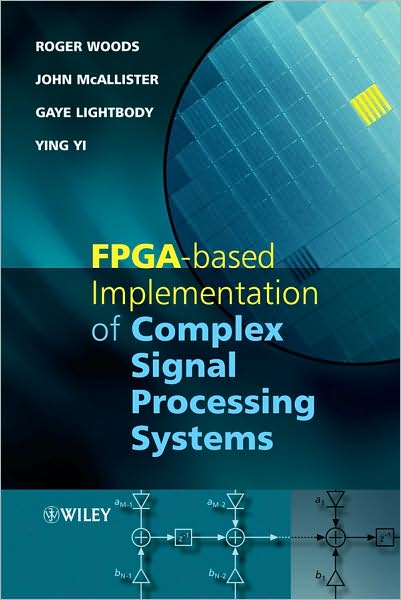 FPGA-based Implementation of Complex Signal Processing System
 Field programmable gate arrays (FPGAs) are an increasingly popular technology for implementing digital signal processing (DSP) systems. By allowing
designers to create circuit architectures developed for the specific applications, high levels of performance can be achieved for many DSP applications providing considerable improvements over conventional microprocessor and dedicated DSP processor solutions. The book addresses the
key issue in this process specifically, the methods and tools needed for the design, optimization and implementation of DSP systems in programmable FPGA hardware. It presents a review of the leading-edge techniques in this field, analyzing advanced DSP-based design flows for both signal flow graph- (SFG-) based and dataflow-based implementation, system on chip (SoC) aspects, and
future trends and challenges for FPGAs. The automation of the techniques for component architectural synthesis, computational models, and the reduction of energy consumption to help improve FPGA performance, are given in detail.
Table Of Contents:
Ch. 1 Introduction to Field-Programmable Gate Arrays
Ch. 2 DSP Fundamentals
Ch. 3 Arithmetic Basics
Ch. 4 Technology Review
Ch. 5 Current FPGA Technologies
Ch. 6 Detailed FPGA Implementation Issues
Ch. 7 Rapid DSP System Design Tools and Processes for FPGA
Ch. 8 Architecture Derivation for FPGA-based DSP Systems
Ch. 9 The IRIS Behavioural Synthesis Tool
Ch. 10 Complex DSP Core Design for FPGA
Ch. 11 Model-Based Design for Heterogeneous FPGA
Ch. 12 Adaptive Beamformer Example
Ch. 13 Low Power FPGA Implementation
Ch. 14 Final Statements Index
Product Details:
* ISBN: 0470030097
* ISBN-13: 9780470030097
* Format: Hardcover, 382pp
* Publisher: Wiley, John & Sons, Incorporated
* Pub. Date: December 2008
Download:
FPGA Prototyping By Verilog Examples

Descriptive Language (HDL) and Field-Programmable Gate Array (FPGA) devices
allow designers to quickly develop and simulate a sophisticated digital
circuit, realize it on a prototyping device, and verify the operation of its
physical implementation. As these technologies have matured and become
mainstream practice, it is now possible to use a PC and an inexpensive FPGA
prototyping board to construct a complex digital system. This book utilizes a
"learn by doing" approach to introduce the concepts and techniques of Verilog
and FPGA to designers through a series of hands-on experiments.
Table Of Contents:
Preface
Acknowledgments
PART I BASIC DIGITAL CIRCUITS
PART II I/O MODULES
PART III PICOBLAZE MICRO CONTROLLER
Appendix A: Sample Verilog templates'
References
Topic Index
Product Details:
* ISBN: 0470185325
* ISBN-13: 9780470185322
* Format: Hardcover, 486pp
* Publisher: Wiley, John & Sons, Incorporated
* Pub. Date: July 2008
Download:
Wuala
Emule
Magnet
segunda-feira, 18 de agosto de 2008
Advanced FPGA Design: Architecture, Implementation, and Optimization

This book provides the advanced issues of FPGA design as the underlying theme of the work. In practice, an engineer typically needs to be mentored for several years before these principles are appropriately utilized. The topics that will be discussed in this book are essential to designing FPGA's beyond moderate complexity. The goal of the book is to present practical design techniques that are otherwise only available through mentorship and real-world experience.
Download:
Wuala
Assinar:
Postagens (Atom)


 Postagens


